Color | Emotions
-
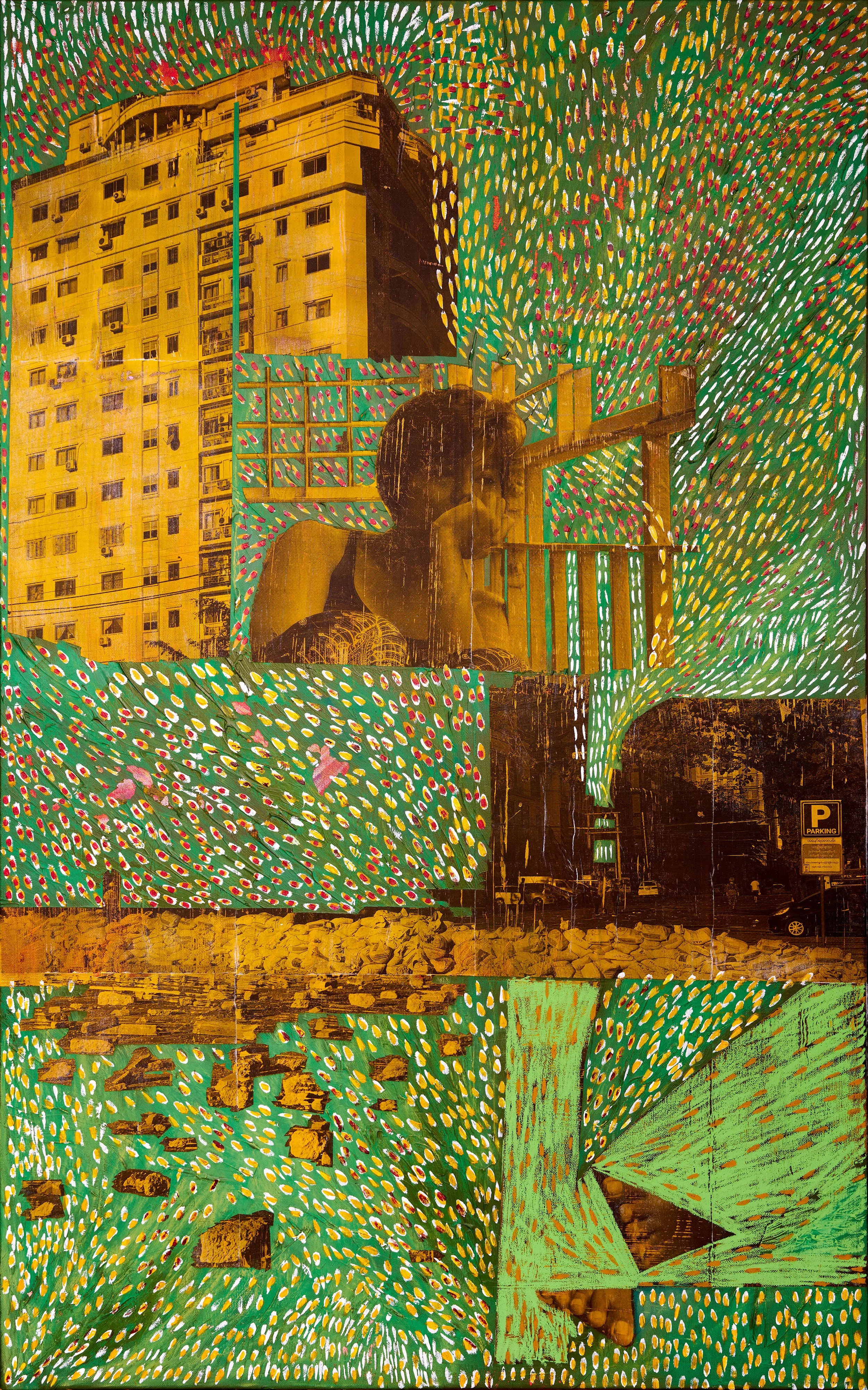
Daze | Neon Isolation
Acquired by the DC Commission on the Arts and Humanities as part of FY 2026 Art Bank Program.
Photo printed on paper, acrylic, oil pastel on canvas
30” x 48”
2024
Daze | Neon Isolation depicts one moment during Myanmar’s 2021 pro-democracy protests from two perspectives.
In downtown Yangon, apartment buildings stand tightly packed—side-by-side, back-to-back, barely any space between them. In Myanmar, it is still uncommon for women to live alone. As a single woman residing independently, I became the subject of unwanted attention, my neighbors spying on my movements, especially when I was on my balcony.
During the protests, though, I began to appreciate my balcony in a new light. Balconies became a vantage point for people to watch for signs of a military presence and a literal platform to shout warnings to my neighbors and the protesters in the streets below. Suddenly, my neighbors and I were allies, our relationship redrawn overnight by the military coup.
I pair a self-portrait taken on my balcony with a photo of makeshift barricades erected to prevent the military entering my neighborhood. I use these photos printed on paper as a base, adding layers of texture using acrylic and oil pastel. I use bright colors such as neon green to represent dissociation, layering elongated teardrop-shaped strokes to represent my amalgam of complex emotions: isolation, grief, anger, strength, and hope, all at once.
-

Embrace | Purplish Nostalgia
Photo printed on paper, acrylic, oil pastel on canvas
18” x 24”
2024
Embrace | Purple Nostalgia is a documentation of feeling lost, afraid, tired, and resilient. In 2021, following a military coup, I was forced to flee my home country of Myanmar (Burma) because of my work on human rights. While the world faced a pandemic, Myanmar faced political violence on top of it.
Stress and grief showed up on our faces: our eyes stopped smiling, our bodies cowered in public, our ears perked up, and our eyes scanned every corner for safety. Our faces started to wear masks: nod, smile, and stay composed. As my body started to adopt survival tactics, the only way for me to process was to document the complex emotions I was feeling. Here, I lay in bed after removing every mask I had to wear. I let myself sit with the solitude.
I use those photos printed on paper as the base, adding layers of texture using acrylic and oil pastel. I scratch the surface to create a rough, scab-like finish. This is how I show trauma—something that is healing but still painful, especially when retriggered.
I add layers of elongated teardrop-shaped strokes to represent the complex emotions—grief, anger, strength, and hope held all at once.
-
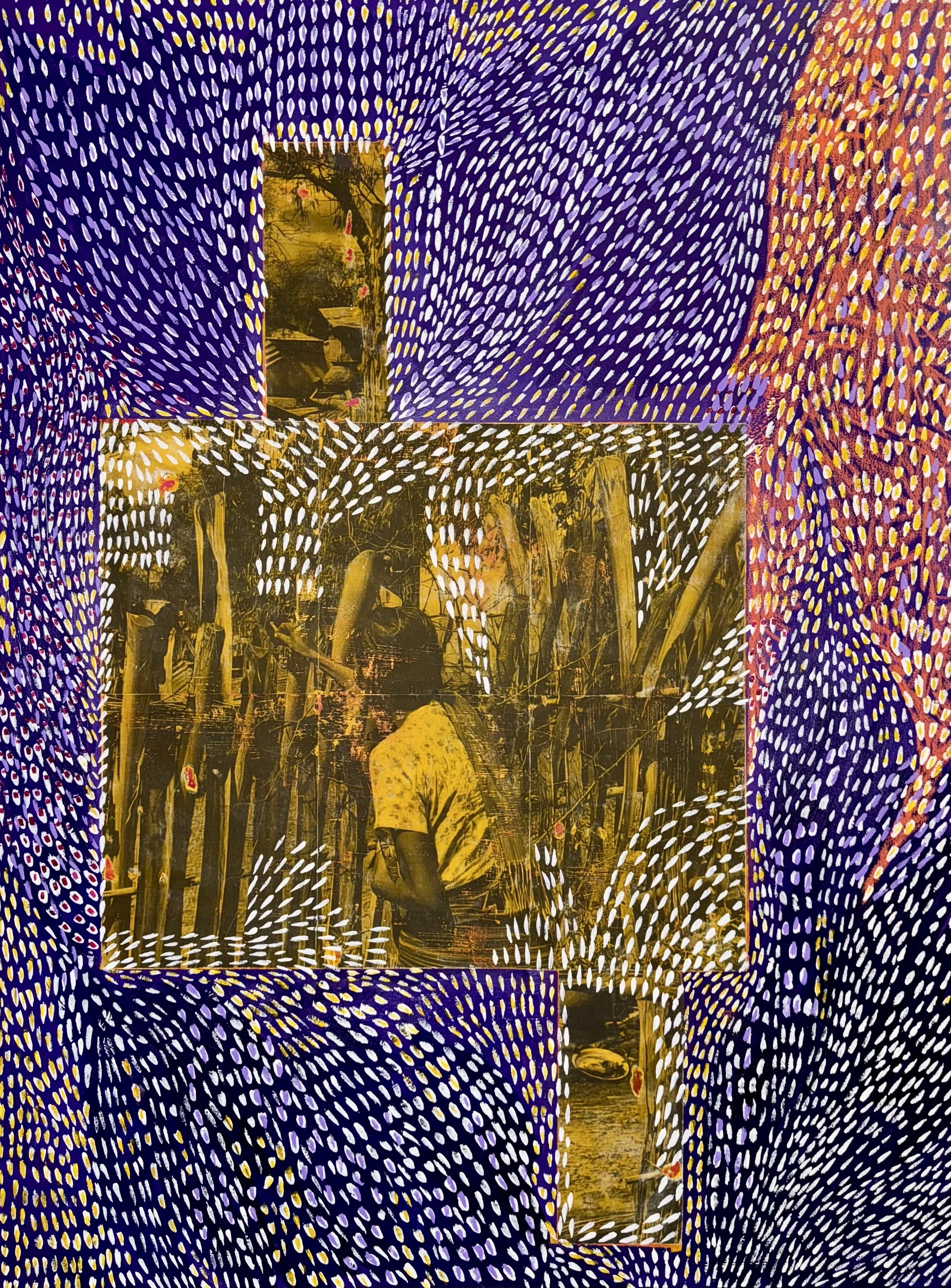
Reminisce | Indigo Resilience
Photo printed on paper, acrylic, oil pastel on canvas
39” x 47”
2024
[Content Warning: This description discusses acts of violence, including murder, committed by military forces.]
Myanmar Now reported that on 17 October 2024, military council forces raided Sipa village in Budalin Township, destroying nearly 300 of its 500 homes. Six people were killed, five of them Sipa residents: U Tin Hlaing (78), U Kyaung Po (65), U Htet Aung (42), U Hla Sein, and U Thein Lwin, all of whom were brutally mutilated. In the photo at the center of this piece, U Kyaung Po’s sister is shown on one of her daily visits to the site of his death, leaving a cigarette in his memory, as he was known for his love of hand-rolled cigarettes.
People like U Kyaung Po’s sister are heroes to me. There are so many people in Myanmar who have lost or been separated from their loved ones because of the military junta. They wake up every day and continue their lives, despite the grief and trauma they carry, and despite the country’s situation. The purple color in this artwork symbolizes hope and aims to soothe those who have lost loved ones, while the layered textures convey the intensity of their emotions.
I long for the day when the military junta is brought to justice for all the crimes they have committed and for the way they have forced U Kyaung Po’s sister and so many others like her to become these everyday heroes.
Photo credit: Myanmar Now -

Witness | Pink Dystopia
Photo printed on paper, acrylic, oil pastel on canvas
30” x 48”
2025
Witness | Pink Dystopia represents the duality present in grief and in turbulent times.
At defining moments of crisis, we feel obliged to always be vigilant, strategizing, protecting our communities, resisting. We feel and are made to feel guilty if we take time to rest, grieve, and process.
As I have grieved the life I left behind in Yangon and the lives lost and irrevocably transformed through Myanmar’s ongoing struggle for freedom and democracy, I have recognized that we must hold space for sorrow and pain while also fighting to heal and endure. In this work, I use cropped self-portraits of my open and shut eyes to illustrate this tension and the difficulty of balancing these synergistic needs: we must resist and rest, witness and cry; receive and process; hold on and let go.
Atop and around my eyes, I add layers of elongated teardrop strokes representing grief. New strokes over old show the evolving nature of grief: past wounds can merge with new ones. These layers reflect the uncertainty of grief and its effects—appearing without warning, bleeding into other losses, and variously leading me to retreat inward, stay still, or drift into isolation.
-
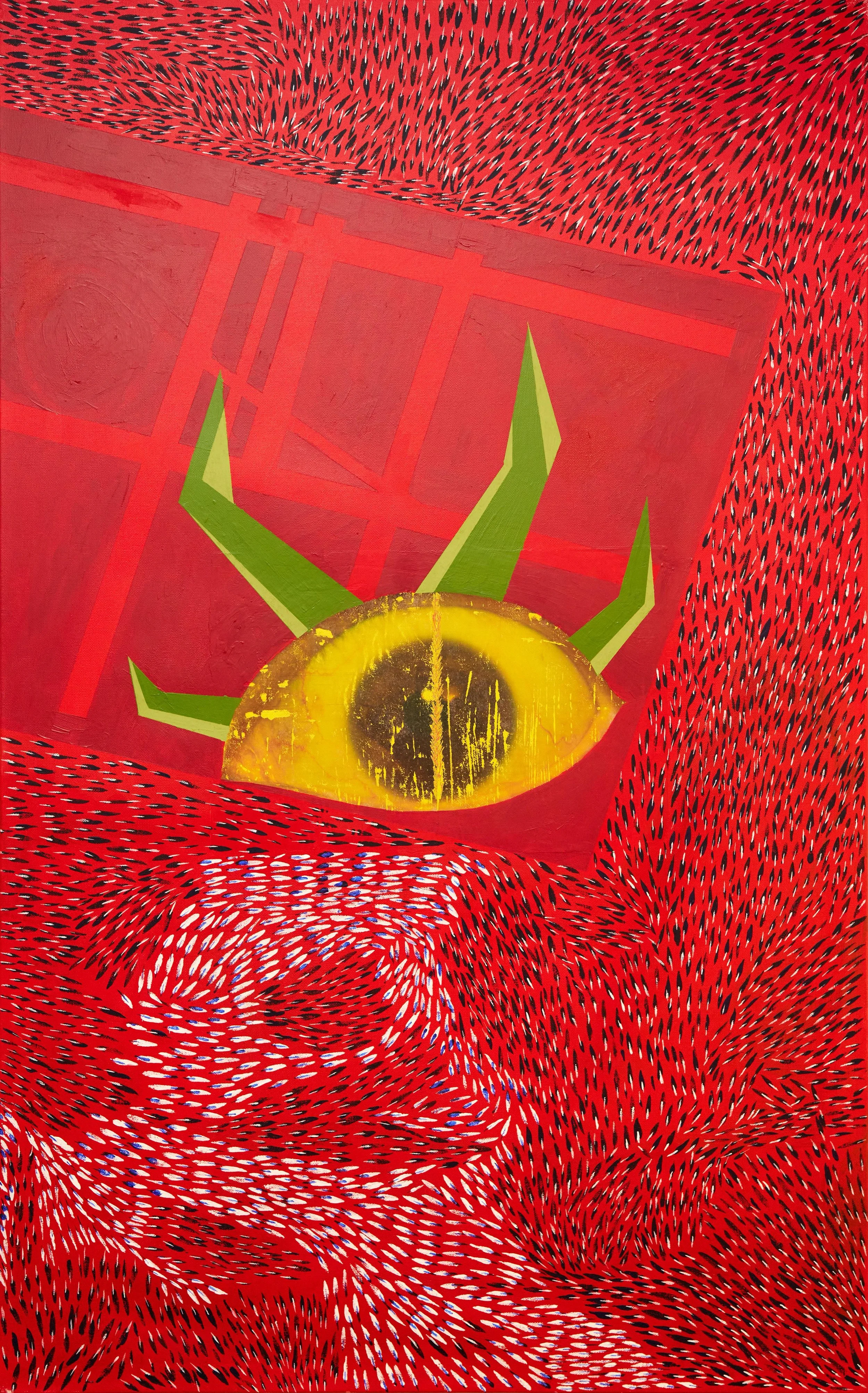
Transcend | Red Dystopia
Photo printed on paper, acrylic, oil pastel on canvas
30” x 48”2026
In Transcend | Red Dystopia, I use my own eye as a central image, overwhelmed, unable to digest every piece of information it takes in, surrounded by a barrier it has built to protect itself. The implied four walls, divided into rooms, represent an intrinsic choice we each have: to find solitude and sanctuary in this era of catastrophe.
Outside those walls, I layer elongated teardrop-shaped strokes to represent the countless events unfolding. But sometimes there is still hope, a light that cuts through, reminding us that love exists in this world, even when we are overstimulated by a constantly negative news cycle. I use a deep red running throughout the work to represent love in all its emotional states: anger, passion, desire, truth, and companionship. -
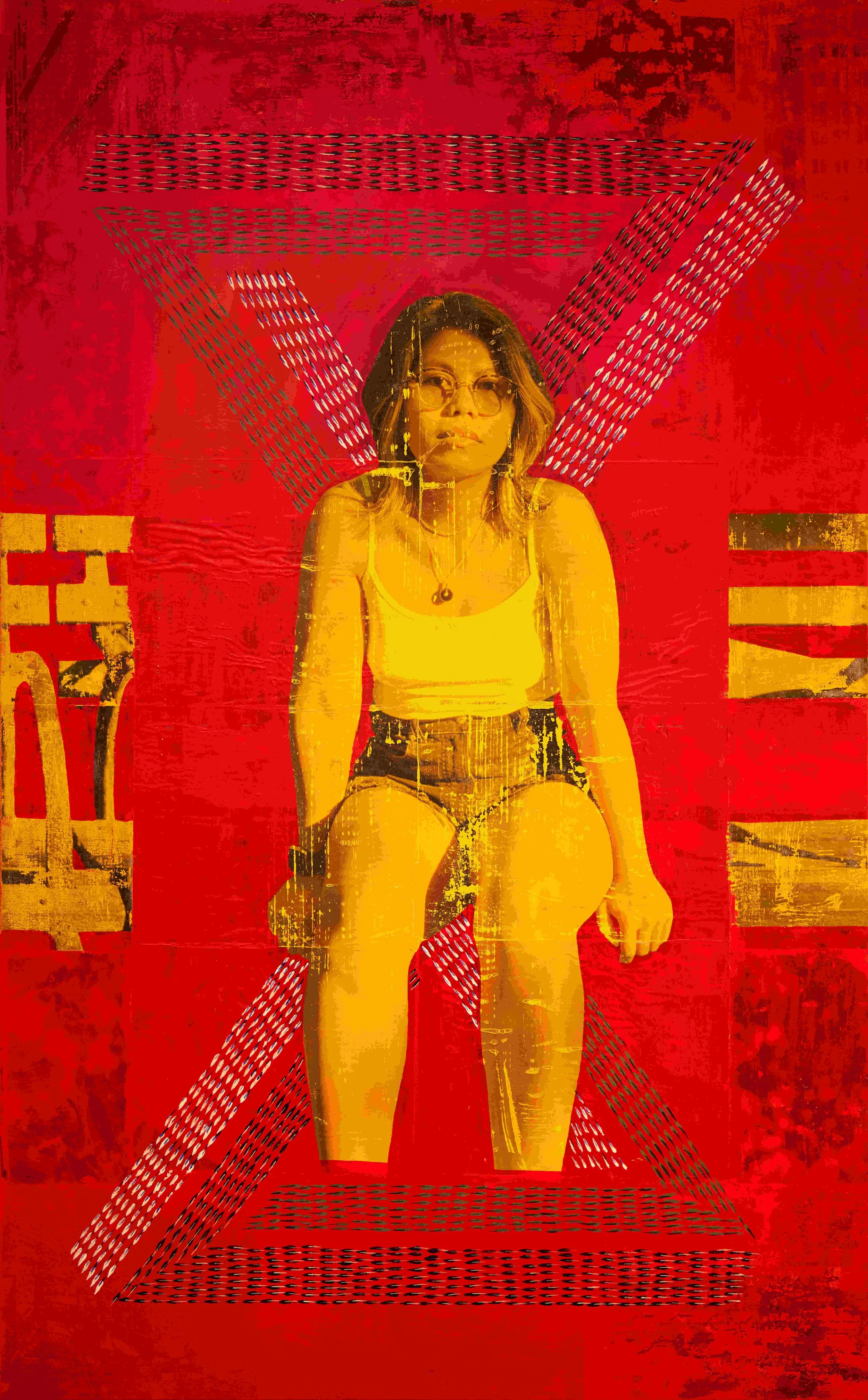
Feeling Orwellian
Photo printed on paper, acrylic on canvas
30” x 48”
2026
Feeling Orwellian includes a photograph of myself. Over the years, there are moments when I find myself stuck, unable to move, unable to change what surrounds me. A friend once offered me an image that captured it precisely: think of yourself as an athlete who plays every season, but this season, you’re being benched.
What is life without hope? I know, with certainty, that it will not always be like this. I have endured and overcome. And yet, these moments can stretch into what feels like eternity. To hold that experience on canvas, I work with elongated brushstrokes shaped into Penrose triangles, that impossible, looping form that never resolves, like an hourglass that counts every grain of sand to reflect what it means to be suspended in waiting.
These layers combined with me sitting on a bench hold the uncertainty of being benched: the restlessness beneath the stillness, the hope that persists even when movement is denied, the knowledge that the season is not over, even when you cannot yet return to the field. -
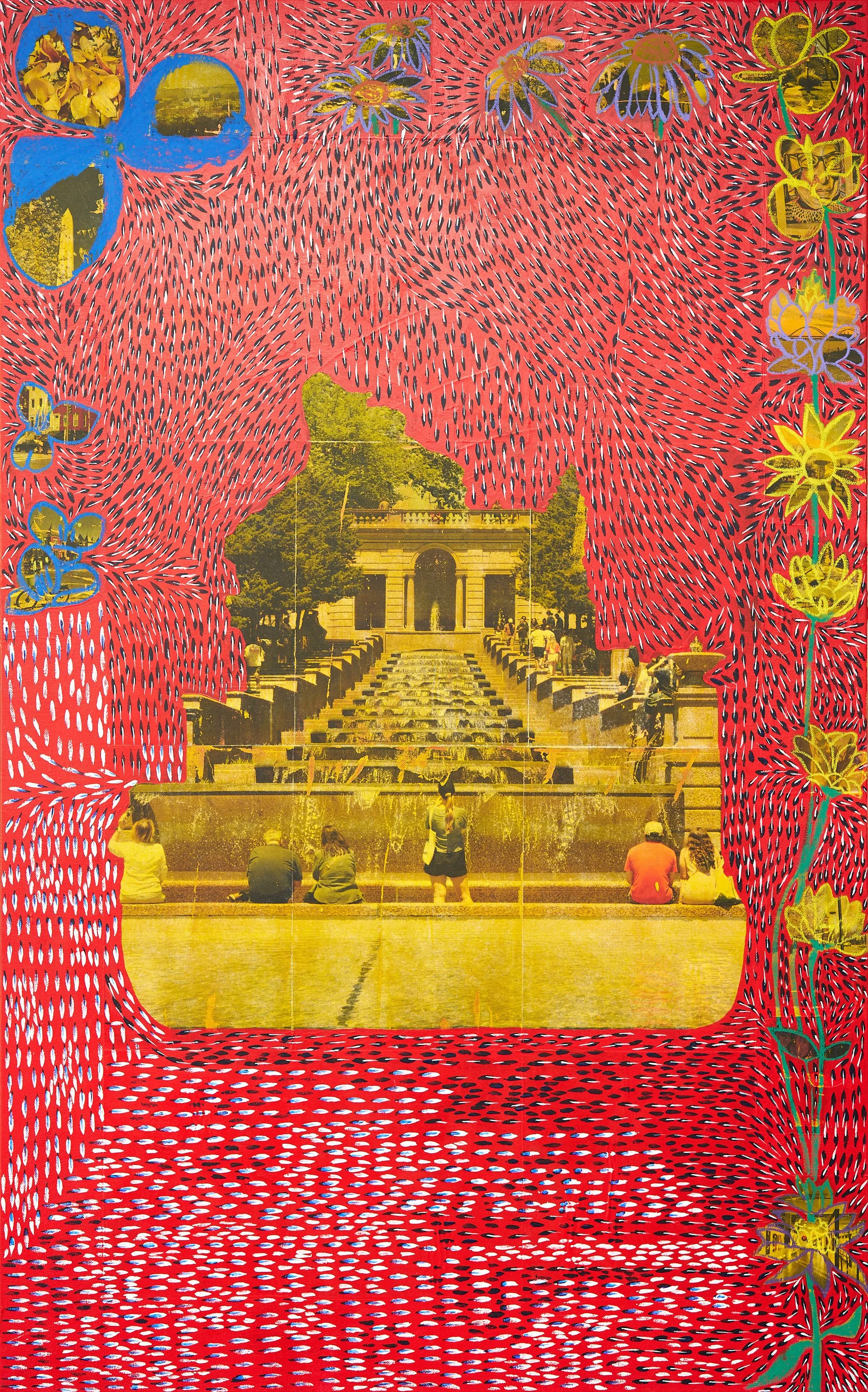
A shared map of the Chocolate City
Photo printed on paper, acrylic, oil pastel on canvas
30” × 48”2026
As I was born and raised in Yangon, Myanmar, I knew the neighborhoods intimately: how they had changed, what they used to be. I have my own Yangon spots that are not tourist attractions. After I moved to DC, I wondered if I would ever feel that way again.
But as time went on, without even planning it, I started finding spots. Quiet places that are not tourist attractions. There’s a park where almost nobody goes. I can walk there alone and sit with my thoughts. When I go back to Logan Circle now, the building I used to live in is completely transformed, but I can point to it and say, I used to live here. That feels like something.
As DC started to feel like home, I realized that this is what immigrants do. It is about making yourself feel at home, finding your spots, and building memories. For this piece, I feature the favorite DC spots of the people in my life and use photos I’ve taken across different phases of my life here. I turned those spots into DC’s native flowers. At the center is Malcolm X Park, also known as Meridian Hill Park, one of the core memories of my Washingtonian friends. I layered elongated strokes to depict the way immigrants and Washingtonians alike move through this city and slowly, quietly, make it their own.